

 4.8
Street Legal Enclosed Mobility Scooters, What You Can Really Drive on the Road

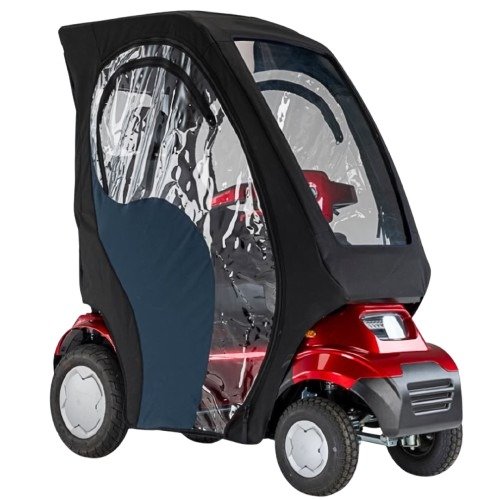
People call us every week asking for a street legal enclosed scooter, and the answer we give on the phone is the one you will read here. No enclosed mobility scooter we sell, and none we know of, is a street legal vehicle. They are mobility scooters with a roof and sides, and in most states the law treats a person with a disability riding one as a pedestrian. That is good news, because it means no license, no registration and no insurance, but it also means the sidewalk comes first and the road is only for the stretches where there is no sidewalk. A few states tie that status to the rider's disability or to the design of the device, so an able bodied rider on a cabin scooter is not automatically covered. This guide explains what street legal really means, where you can ride an enclosed scooter, which models carry lights and mirrors, and what to do if you truly need something you can drive on the road.
What street legal actually means
In the US a vehicle is street legal when it is built as a motor vehicle for public roads, meets the federal safety standards for its class, and your state lets you register it. The smallest federal class built for public roads is the low speed vehicle. Federal rules define it as a four wheeled vehicle that reaches more than 20 mph but not more than 25 mph and weighs under 3,000 lb, and standard FMVSS 500 then requires headlamps, stop lamps, turn signals, tail lamps, reflectors, mirrors, a parking brake, a windshield, a vehicle identification number and seat belts. Most states then let you register and insure an LSV, give it a plate, and drive it on roads posted at 35 mph or less with a driver license. Golf carts and mopeds are the other way onto a public road, under each state's own rules rather than a federal standard.
An enclosed mobility scooter fails that test at the first line. The Afiscooter S4 tops out at 9.3 mph, or 11 mph with the speed upgrade. The Shoprider Flagship runs 7 mph. Even the fastest cabin scooter we sell, the Q Express at 18 mph, sits under the 20 mph floor, carries no VIN and was never built or certified to the standard. There is no form you can file and no part you can bolt on that turns one into a low speed vehicle. Anyone who tells you otherwise is selling you something.
Where you can ride an enclosed mobility scooter
Where a state counts the rider as a pedestrian, an enclosed scooter uses the sidewalk, the crosswalk and the curb cut the way a person on foot does. Where there is no usable sidewalk, nearly every state lets you use the shoulder or the edge of the road facing oncoming traffic, the same rule that applies to someone walking. That is the road use pedestrian law gives a mobility scooter.
Stores, parks, parking lots and the paths of a retirement community are a different layer of law. Access there comes from the ADA, which requires a wheelchair, meaning a device built for a person with a mobility disability, to be allowed anywhere open to the public on foot. A wide enclosed cabin is the kind of machine a store or a park may assess for size and safety before letting it in, so a narrow S3 or Flagship gets through doors a Q Express will not.
The exact wording changes from state to state, and a city can add its own rules on top. Our state by state road rules guide has the statute for every state in one table, and our California enclosed scooter guide goes deep on the one state that asks us most. Golf cart communities and private roads are a different matter. They set their own rules, and an enclosed scooter is usually welcome where golf carts are, so ask the community office before you buy.
Bike lanes are the gray area. Oregon and Rhode Island give a motorized wheelchair rider the rights and duties of a bicyclist in a bike lane or path, Louisiana lets an electric mobility aid use marked bike lanes and paths, several states leave bike paths to the city, and most say nothing, in which case the lane is part of the road edge you may use only where there is no usable sidewalk. If a bike lane is on your daily route, check the state table and then call your city.
Two person enclosed scooters and the road
A two seater is still not a vehicle. The Afiscooter S4 Dual Seat and S3 Dual Seat and the Cheetah Ninja ADA 2 Seater are still mobility scooters, so they cannot be registered or plated. The second seat does change one thing. The pedestrian status states write into their codes is for the person with the disability, not for a passenger, so a cabin carrying two people is the kind of machine a state or a venue may see as closer to a golf cart. Plan a two seater for sidewalks at walking pace, private roads and communities, not for public road use. A two person street legal enclosed scooter does not exist as a mobility scooter. If you want to carry a passenger on public roads, the real options are a two seat low speed vehicle, which is a real product, or a golf cart in a community that allows them on its streets. Our two seater mobility scooter page covers the models, the sizes and what fits in a truck bed.
Speed is what changes the rules
Most states that draw a line draw it by speed, and the enclosed scooters we sell fall on both sides of it. The Afiscooter and Shoprider models run 7 to 11 mph and sit under every speed cap we found, though a state that ties pedestrian status to the rider's disability or the device design, as California does, still applies those tests. The Cheetah Ninja at 14 mph and the Q Express and Gio Golf at 18 mph are a different conversation. At that speed the machine is outside the wheelchair definition in every state that sets a cap, and what it becomes varies, from no public road class at all to a motorized scooter or similar label with rules about license, lights, helmets and where it may run. Riding one on a sidewalk at 18 mph is also a quick way to meet a police officer. We tell buyers of the fast cabin models to plan on private property, community roads and the slow speed setting in public, and to check their state row in the guide before the first trip.
Lights, mirrors and the road edge
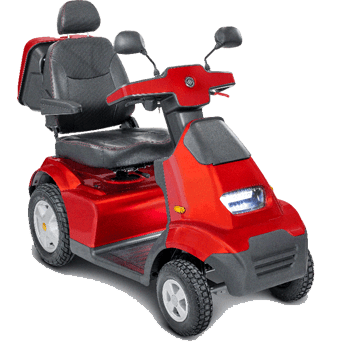
Lights do not make a scooter street legal, but they make the road edge a lot safer, and several enclosed models come with a full set. Every Afiscooter S3 and S4 canopy model ships with an LED headlight, turn signal blinkers, a horn and dual rear view mirrors, and the windshield wraps wide enough that there is no blind spot. The Shoprider Flagship adds a complete lighting system plus a windshield wiper and washer, which matters more than it sounds the first time you are caught in rain at dusk. The Gio Golf has LED headlights, turn signals, a horn and a backup camera.
Two things we add for customers who ride a road edge regularly. The amber flashing roof beacon on the Afiscooter models is a cheap add on that drivers see from a long way back. And the slow speed setting is there for a reason, since a scooter creeping along a shoulder at 4 mph is read by drivers as a pedestrian, while one doing 11 mph is read as something they must overtake.
Which enclosed scooter fits your use
These are the three we fit most often, each for a different reason. The full comparison of every enclosed model is in the table below it.
Three enclosed scooters we fit most often
- #1Best overall
Afiscooter S4 Dual Seat Fully Enclosed
The two person enclosed scooter that stays inside the pedestrian speed band at 9.3 mph, with a headlight, blinkers, horn and dual mirrors as standard and a 33 inch dual seat. The one we recommend to couples who want to ride together without a license question.
See price & details- Pros
- Two full seats under one canopy
- Headlight, blinkers, horn and mirrors standard
- 9.3 mph keeps it a pedestrian device in every state
- Cons
- Too wide for small shops and transit lifts
- Needs a trailer or a truck bed to travel
- #2
Shoprider Flagship Cabin Enclosed
The fully enclosed cabin with doors, a complete lighting system and a windshield wiper and washer. At 7 mph it is the slowest scooter here and the one with the least legal gray area, which is exactly why riders in rainy states buy it.
See price & details- Pros
- Real cabin with doors, wiper and washer
- Full lighting system
- 7 mph top speed, pedestrian everywhere
- Cons
- 350 lb capacity
- Slow for long road edge stretches
- #3
Afiscooter S3 Fully Enclosed
The single seat all terrain enclosed scooter with the tightest turning circle of the three, 11 mph with the upgrade, 37 miles of range and the same headlight, blinkers, horn and mirrors as the S4. Our pick for a rider who mixes sidewalks, parks and the occasional road edge.
See price & details- Pros
- 56 inch turning radius
- Up to 37 miles per charge
- Lights, horn and mirrors standard
- Cons
- Three wheels are less stable on side slopes than the S4
- 11 mph needs the speed upgrade


Enclosed mobility scooters, speed, seats and road edge equipment
| Model | Top speed | Seats | Lights and mirrors | Price |
|---|---|---|---|---|
| Afiscooter S4 Fully Enclosed | 9.3 mph, 11 with upgrade | 1 | LED headlight, blinkers, horn, dual mirrors | $7,995 |
| Afiscooter S4 Dual Seat Fully Enclosed | 9.3 mph, 11 with upgrade | 2 | LED headlight, blinkers, horn, dual mirrors | $8,599 |
| Afiscooter S3 Fully Enclosed | 11 mph | 1 | LED headlight, blinkers, horn, dual mirrors | $7,849 |
| Afiscooter S3 Dual Seat Fully Enclosed | 9.3 mph, 11 with upgrade | 2 | LED headlight, blinkers, horn, dual mirrors | $8,449 |
| Shoprider Flagship Cabin | 7 mph | 1 | Full lighting system, wiper and washer | $7,495 |
| Cheetah Ninja ADA 2 Seater Canopy | 14 mph | 2 | Windshield and hard top | $6,996 |
| Q Express Fully Enclosed Cabin | 18 mph | Driver plus rear bench | Full cabin with doors | $7,683 |
| Gio Golf Fully Enclosed | 18 mph | Driver plus rear bench | LED headlights, turn signals, horn, backup camera | $6,299 |
If you are not sure which side of the speed line your state and your route fall on, call us at 1-888-233-5563. We have sold these scooters to riders in every state and we would rather talk you out of the wrong one than ship it. For the full range see our enclosed mobility scooters with roofs and canopies.
Frequently asked questions
Are enclosed mobility scooters street legal?
No. An enclosed mobility scooter is a mobility device, not a vehicle, so it is not street legal in the way a car or a low speed vehicle is. In most states the rider is treated as a pedestrian, which means no license, registration or insurance, sidewalk first, and the edge of the road only where no sidewalk exists. Check your state row in our road rules guide and ask your city before riding on any road.
Do you need a license to drive an enclosed mobility scooter?
No, not for a mobility scooter used as a mobility device. Licensing attaches to motor vehicles. The one caution is speed. An 18 mph cabin scooter is outside the wheelchair definition in every state that sets a speed cap, and on public roads some states may then apply motorized scooter or similar device rules, which can bring a license requirement. The 7 to 11 mph models sit under every cap we found, though a state like California still asks whether the rider has a disability.
Can I make my enclosed scooter street legal?
No. A street legal low speed vehicle has to be a four wheeler built for more than 20 and not more than 25 mph, certified to federal standard FMVSS 500 and carrying a VIN. A mobility scooter has none of those and no state will register one, no matter what lights or mirrors you add. If you need to drive on public roads, you need a low speed vehicle or a car.
Is the Q Express street legal?
No. The Q Express is an 18 mph fully enclosed cabin mobility scooter, not a low speed vehicle, and it cannot be registered or plated. It is sold for private property, community roads and pedestrian use at a sensible speed. At 18 mph it is outside the wheelchair definition in every state that sets a cap, and on public roads some states may apply motorized scooter or similar device rules. Check your state before you buy it for road use.
Are two seater enclosed scooters allowed on the road?
A two seater enclosed scooter is not a street legal vehicle and cannot be registered. The pedestrian rules states write are for the rider with the disability, not a passenger, so plan it for sidewalks at walking pace, private roads and communities rather than public road use. On private roads and in golf cart communities it is usually welcome wherever golf carts are allowed.
Can I ride an enclosed scooter in a golf cart community?
Usually yes, and it is one of the best places for one. Golf cart communities and gated developments set their own rules for their private roads, and most treat an enclosed mobility scooter like a golf cart. Ask the community office for its vehicle rules before you buy, since a few limit speed or require a flag or a beacon.
Can I use a bike lane with an enclosed mobility scooter?
It depends on the state and the city. Oregon and Rhode Island give a motorized wheelchair rider bicyclist rights in a bike lane, Louisiana lets an electric mobility aid use bike lanes and paths, several states leave bike paths to the city, and where the statute is silent the lane is part of the road edge you may use only where there is no usable sidewalk. Look up your state in our road rules guide and ask your city if a bike lane is on your route.
Sources & references
- NHTSA, low speed vehicle definition, 49 CFR 571.3 Authority
- NHTSA, Federal Motor Vehicle Safety Standard No. 500, Low speed vehicles (49 CFR 571.500) Authority
- US Department of Justice, ADA requirements on wheelchairs and other power driven mobility devices Authority
- California Vehicle Code section 467, definition of pedestrian Authority
- Heavy Duty Mobility, Are electric wheelchairs and mobility scooters allowed on the road, state by state